![]()
First, a definition: Lacy Glass is the term given to the first glass products
pressed
in America and on the European Continent. It was made by various glass factories
but commonly mistakenly referred to as "Sandwich Glass", a reference to the
Boston Sandwich Glass Co. It is heavy, thick and crude and was not made in
"sets" or "patterns" of dishes, although the various pieces are known today as
a
particular "pattern" name for
identification purposes. Any colored pieces found
today would be extremely
rare as most of those are
in advanced collections or museums.
| Helpful principles about Lacy Glass: 1) Lee and McKearin have the broadest range described in their readily available books. 2) Main sources are either Sandwich or Pittsburgh. Lowell Innes book is the reference for Pittsburgh glass but it gives no prices & is well over $100 in price. Barlow and Kaiser are very good for Sandwich lacy. They give the only prices readily available I know of (other than 5 or so pieces in Kovels) & auction guides. |
| 3) Pieces
made in Pittsburgh usually rest on little knobs on the bottom that look
like
part of the design from above. 4) Pieces made by Boston & Sandwich frequently contains cables. 5) "Looks like" does not count in identifying lacy glass. It must match exactly. Many pieces have many design elements. The size is VERY important to values. And the EXACT pattern and size determine rarity. 6) large open bowls (or deep dish) tended to warp when produced and are rather rare. |
![]() |
This is a fiery opalescent
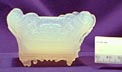
master salt Crown Pattern ca 3" x 2" at the top. Neal # CN 1b pg 48 "very rare". Boston Sandwich ca 1830's |
![]() |
7) Condition:
Slight underfills do not affect price much, but be sure that what looks
like underfill is not ground away (it looks like
underfill). Missing scallops are almost to be expected but that does affect
the price & desirability of any glass. Manufacturing flaws are usually acceptable
but perfection, is the goal, albeit one not frequently met. 8) Is it reproduced? Most likely not although the Sandwich Glass Museum has reproduced some lacy salts & possibly other pieces. The WORK it would take to reproduce such a piece! If it's lead (long ping) it's either very good reproduction or original. Quality reproductions (detail) I am aware of are the MMA repros of the Peacock Eye pattern (see below). |
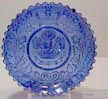
| Lacy glass was also made "on the Continent". This 4 1/4" cobalt blue toddy plate was issued to honor the birth of the Prince of Wales to Queen Victoria and Prince Albert in 1842. |
![]() |
They were sold for
nearly the
amount of real ones,
except they are in rare colors. 9) Is it genuine? The most choice pieces have made it through almost 2 centuries in good condition, but in judging authenticity you may find uneven thickness and large "plaques" or areas of thickness in the surface caused by too rapid cooling (annealing) in the leer. There may be one inch or larger rectangles separated from each other by jagged lines. This IS surface "scum" and was much rarer after the switch to coal. It is VERY shallow. 10) Lacy glass does not scratch easily, but it chips. The NUMBER ONE DIAGNOSTIC is the same feature that caused the lacy glass to be decorated that |
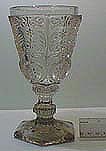
| This goblet is an example of French lacy glass; DEAMANTE ET FEUILLES
pattern pictured in McKearin's book Pl. 138 |
| way in the first place. Look for irregularities and swirls. Those are unacceptable in today's production and these would not be sold on the primary market without embarrassment to the manufacturer. A perfectly smooth edge could be an indication of modern production. |
![]() |
11) Value? About $100 for a common bowl. Generalizing, the market is failing because it is so rare. On the open market, there are few knowledgeable collectors. Although prices for rare & desirable pieces continue to rise at auctions, the Shield and Acanthus creamer DROPPED from $500 to $300 between 1984 and 1998 in the Barlow and Kaiser guides. An octagonal Eagle plate valued |
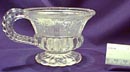
| This lacy cup with a molded handle may be foreign-made. We are unable to identify it. If you are, please share. |
| in B & K at $600, lists it the new price guide at $300.
To keep on top of the prices of lacy you need to follow the auction
catalogs; finding a piece at all (other than the ubiquitous cup plates)
is a rare & fine occurrence. 12) Given the age of this type of glass and the circumstances under which it was produced (no quality assurance inspections as we know them today) SOME damage in the way of chips/ flakes is a sine qua non of pieces of original lacy. Mrs. Lee pointed this fact out frequently in her books. Barlow and Kaiser make the comment to |
| the effect that Sandwich had a high regard for professional standards and that FOR PATTERN GLASS, pieces did not leave the factory chipped. The emphasis is to separate the standards for lacy glass in the 1830s & 40s from the pressed patterns of the 50s forward. Pattern glass was produced after the switch to coal and the glass was more pourable and tractable. It released from the mold cleaner and was cooled more efficiently. It could be scrapped in favor of a better specimen, and it was. | ![]() |
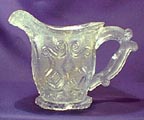
SHIELD MEDALLION Boston/Sandwich Glass Co. ca
1830's creamer w/ molded handle ca 4 1/2" high. |
![]() |
![]() |
|
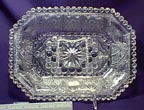
Pittsburgh (Midwestern) Lacy ca 1835. 6" x 9";
RW Lee Sandwich pl 102 also Innes Pg 274, pl 285 #2 |
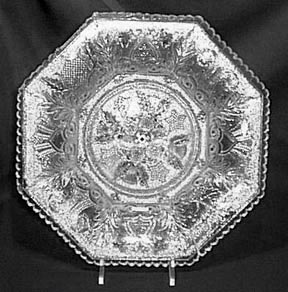
The octagonal Lacy Beehive
plate is reported by Lee to have been the most common cake plate
produced at Sandwich. |
![]() |
![]() |
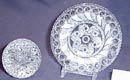
| The earliest known
pieces to be pressed in America in the late 1820s or '30s are thought
to have
been heavy glass knobs and cup plates and sauce dishes. Here are
a flint cabinet knob in the Petal & Shell pattern ca 2 1/4" diam.
gifted to PatternGlass.com by
Mr. & Mrs. John Welker ---and a sauce /toddy plate in the lacy Peacock Eye pattern ca 4 1/2" OD Boston Sandwich Glass Co. ca 1840's. Lee's Sandwich pg 86; plate 85. |
|
| There are a number of pages showing
many examples of lacy glass most of which are for sale beginning
with the link by clicking HERE. If you are interested in purchasing them, please get in touch. Remember, this Pattern Glass School is a Cooperative site and your additions, corrections and suggestions are welcome- email us. |