
|
| The Glass of New England 1818-1888 The glass industry was attracted to New England for many of the same reasons it was attracted to other locations throughout history; access to natural fuel resources, availability to world marketplaces, and a ready work force. Of the many glass houses in New England in the early to mid-1800s, two of the best known were The New England Glass Company and The Boston and Sandwich Glass Company. The New England Glass Company was located in the Cambridge area of Boston. The use of the term "Cambridge Glass" in literature has led to some confusion with the somewhat later Cambridge Glass Company of Cambridge, Ohio. |
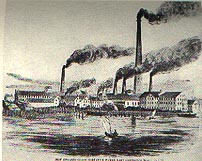 |
The New England Glass Company was incorporated in 1818. Deming Jarvis, the only one of the four owners with practical business experience, was to run the shop. Mr. Jarvis, born in Boston into a wealthy family, had working experience in the dry goods business before joining the NEGC. He had a unique talent for selecting the right men and getting them to come to work for him, including some of Europe's most skillful cutters. Deming's father died in 1823, leaving him with considerable wealth and he spent some time in Pittsburgh |
| studying the local methods of glass making. In the beginning, the NEGC had two furnaces, twelve pots & a cutting department with 24 cutting mills. The shop was an immediate success. During 1823, 140 workers produced ten tons of glassware weekly, a great deal of which was cut and sent to Boston for sale. Much of the company's success was credited to the head gaffer or superintendent, Thomas Leighton Sr. who came to the NEGC in 1826. He was the father of 7 sons, 6 of whom became glass workers and he was known for hiring the best man for the job. Deming Jarvis left the NEGC to supervise the construction of The Sandwich Glass Company. He was succeeded by Henry Whitney who remained manager of the company for twenty years. The glass pressing machine, invented in ca 1825, greatly increased production in all of the glass houses. By 1828, the NEGC products were being marketed through New York, Philadelphia and Baltimore. |
| By
1849, it was recognized as the largest glass company in the world with 500 employees.
This huge volume of flint glass production necessitated the use of 2 1/2 tons
of lead each year. Lead dust in the air and on the floor and work surfaces exposed
the workers to dangerous lead poisoning. In 1864, after having moved to Hobbs, Brockunier & Co from NEGC, William Leighton, a son of Thomas Leighton, developed a successful soda lime formula for glass, eliminating the need for lead in the mix. The new soda lime glass was safe, cheaper to make, and better for pressing because it was harder, thinner and cooled faster. |
 |
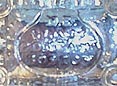 |
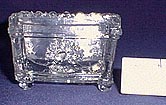
| Probably a product of the 1820s this crudely pressed master salt has the look of a flower box and the underside has the molded words "N.E. Glass Company Boston". It measures 2 7/8" x 2 1/8" at the top and is one of very few examples of early flint glass signed with the name of its maker. | ||
 |
Lead
glass is softer and better for cutting and there was much discussion among
companies about whether to switch to the new formula or continue with the
flint. Nearly all the other companies changed for economic reasons but the
NEGC, believing the new glass to be inferior, refused to change resulting
in their suffering enormous competition. |
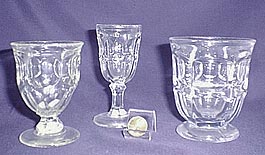
| Ashburton pattern made ca 1840s came in a large number of forms including those pictured here: an egg cup, stemmed wine and footed tumbler. |
| This was essentially the beginning of the Brilliant Cut Glass
period in America and in the minds of the NEGC officials, vindicated their choice
to stay with the use of only lead glass. Nevertheless, the 1870s were difficult times for the NEGC because of competition of the cheaper glass, mismanagement of the officers & directors, the loss of most of the skillful workers and the dishonesty of remaining workers, many of whom were making and selling competing products on their own. The buildings and materials were put up for sale in April 1877 and it was leased to Wm. Libbey in 1878. Lack of fuel plagued the New England |
 |
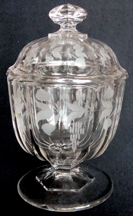 |
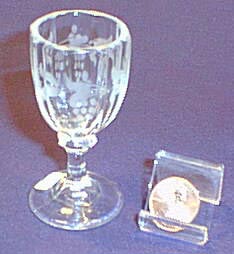
| Huber pattern was made in an extensive line in both plain and "vintage" etching ca 1860s. Above is a tiny engraved cordial and a large engraved covered sugar bowl, seen HERE in our Pattern Glass Sugar Bowl Store. | ||
 |
 |
companies; pine forests were depleted and coal had to
be shipped in at great expense. Mr. Libbey, however, continued to make first quality
products and to introduce many new color lines. After his death in 1883, his son, Edward, who had been named a partner in 1880, took over the reins of the renamed firm, Wm. Libbey & son. Labor Unions formed by glass workers led to problems and dirty tricks leading to strikes in thirty New England glass houses at one time and the closure of Wm. Libbey & Son for six months. When the Company reopened, Edward said that if the fires died again, he would never rekindle them. |
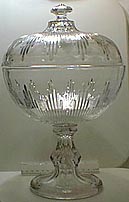
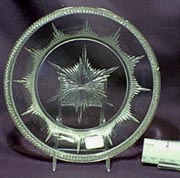
| Blaze, a flint pattern
made made ca 1869, in an 8" covered compote and a 6" plate. The plate is for sale HERE. |
||
 |
And so when another strike occurred in 1888, he closed the plant and moved to Toledo, Ohio where he and many of his workers continued to make fine cut glass under the name of Libbey Glass Company. One year later, the property of The New England Glass Company was sold and in 1921 the great chimney was taken down. During the life of the company pure, clear, flawless and beautifully finished glass equal to any in the world was produced. Early pieces had rough pontils but later they were ground and fire polished. | 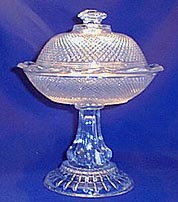 |
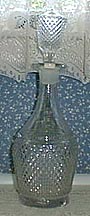
| A DIAMOND POINT decanter with matching blown stopper from the 1850's is for sale HERE. | Glass was cut, etched, acid treated and satin finished by some of the most skilled workmen in the business and beautiful colors such as ruby, brown, black; emerald & light opaque green; dark, turquoise, powder & opaque blue; purple, canary yellow, rose and pink alabaster were produced. | A covered compote or 'sweetmeat' in Sharp Diamond pattern from the 1870s is for sale HERE. |
| Many pieces were gold gilded
or opalescent and in the 1880s, art glass types were developed including amberina,
peach blow and pomona. NEGC was the only company to make the ruby layered
and cut away style lamps. Some of the Company's other well-known flint glass patterns
are WASHINGTON, NEW YORK and VERNON HONEYCOMB. And while
their flint glass was said to be clearer with unusual weight and ring, much
of it has been misidentified in early pattern glass literature. Glass workers were a close knit group, living in company provided cottages in small, neat sections of town. Before alarm clocks, a watchman went door to door calling out their names and telling them it was time to go to work. Families intermarried, sons followed fathers for generations and we recognize the same family names, such as Leighton & Libby as we study glass history. |
 |
 |
 |