| Flashed! | Stained! | |
| Cased! | ||
| What's the Difference? | ||
If the use of
these terms leaves you seeing red, you are not alone.
Long time EAPG folks sometimes disagree on the terms partly because the
Dictionary definitions and the present day vernacular are not always the same.
This will be an attempt to clear up some of the questions
but don't be
surprised if the next person you talk EAPG with disagrees with it!
We'll start with published definitions.
![]()
Flashed!
|
From "An
Illustrated Dictionary of Glass" by Harold Newman. |
![]() |
Also
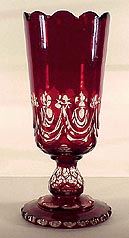
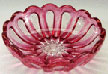
known as plating, flashed glass is sometimes cut through to the
thicker layer beneath the
flashing. Some early New England Glass and Sandwich pieces were made
with this process, and a lot of the European cut-to-crystal is
flashed. Flashing
was a more expensive process and not used for EAPG tableware. The
flashing is probably about as thick as a sheet of paper & can
still be scratched through, but not as easily as staining. |
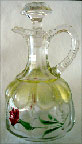
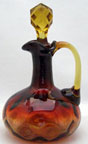
A ruby flashed celery vase from Karen's Collection.
Likely European. |

![]() |
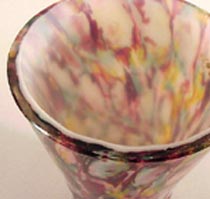
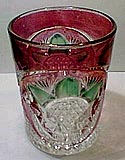
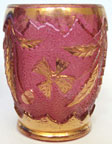
Cased glass: see Overlay glass: A technique of putting successive layers of different colors of glass over an object and cutting away areas to expose the layers of color. At the left is a close up of a piece of Karen's Cottage Glass showing the cased layers. |
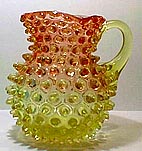
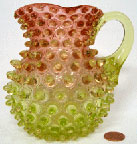
| Hobb Brockunier's rubina verde ca 1884 (right),
has a vaseline or canary glass body plated with a gather of ruby lining
the upper part of the body. The glow you see when placing it under a black
light is the vaseline on the outside. If you put your hand inside,
run your finger over the place where the two colors meet, you can feel a
change in the thickness of the glass where the ruby glass layer ends.
The red color is definitely glass and not staining. Hobbs also used ruby
plating, a thin layer of ruby glass, over amber,
clear, blue, etc. to produce their Ruby Amber
and other part-ruby colors. Tom Bredehoft adds: "I consider casing to be sequential layers of glass accumulated on the initial blow pipe. Plating may be applied on the inside after the piece is made, as with the PRESSED rubina verde pitcher in your example. Plating can also be in reference to gathers. Some authors use cased and plated interchangeably." |
![]() |
![]()
Stained!
| Welker defines Staining: "A process of coating a piece of glass with a chemical whose true color is developed by heat. This is the least expensive way of coloring glass. The staining material is painted on the annealed [cooled] article with a brush wherever the decorative effect is desired. It is then fired on for permanency at which time the glass assumes the desired color." (see examples below) |
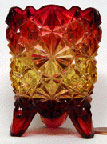
| Ruby (and amber) staining
probably began as an inexpensive imitation of flashing. Since you can apply
stain more selectively, it became more than an imitation, of course. Because recent authors have used "flashed" and "stained" interchangeably, some think that flash & stain were the same process by different names, but as we now see, they really aren't. While they are frequently both used to mean fired-on coloring added after the glass piece was made,that process is properly called staining, whether the glass is new or old. |
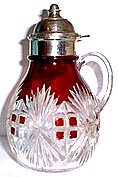
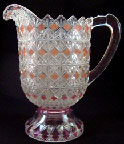
![]() A ruby stained Majestic pattern syrup pitcher by McKee ca 1893. |
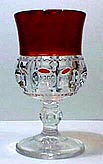
![]() A deeply stained King's Crown aka Ruby Thumbprint wine by Adams ca 1890 |
As we know, all that is stained
is not ruby! Amber staining was used as were greens and blues and even some
purples & yellows. Bill Heacock mentions that one of the master engravers at the Duncan factory in Pittsburgh developed Duncan's amber stain, and that he had come from Bohemia, where amber staining was used extensively. It may be that staining was used first in Bohemia, where a lot of flashed glass was also made. |
![]() This amber-stained Finecut & Block jelly compote is King #25 by King Glass Co. ca 1885. This pattern was also produced in blocks stained blue, pink and yellow. |
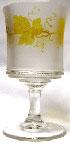
![]() Ribbed Droplet Band aka DUNCAN #89 ca 1887 is frosted with amber/ yellow vintage leaf design. |
And obviously all color was not created equal. Some, such as the deep, rich pieces of Ruby Thumbprint were created with chemical dyes acting on the surface of the glass. The Buckingham tumbler at right from the tail end of the EAPG era was colored with a ceramic glaze added on to the glass after it was made. Its color looks thin and blotchy. |
![]() A product of U S Glass (#15106) ca 1907 this Buckingham, aka Crosby tumbler is not an example of fine staining craftsmanship. |
![]() |
And all that is stained RED is not
ruby! Some staining is more of a "Rose" color and some of
the lighter pieces by the U S Glass Co. are actually referred to as "Maiden's
Blush",
such as the TEXAS state pattern ca 1900 at left. An overall "wash" of stain such as the rose colored cov'd butter dish below left has highlights of gold decoration. The butter dish is in the U S Glass Co DELAWARE pattern ca 1899. Many present day pattern glass folks refer to the painted gold decor on EAPG as "gold flashed" thus compounding the confusion of nomenclature. |
![]() A colorful BIRD & STRAWBERRY creamer with gold paint trim by Indiana Glass Co. ca 1910. |
![]() |
||
![]() |
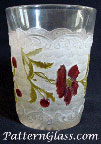
The Bohemian tumbler at left, also a U S Glass product from ca 1899 combines the frosted or "camphor" look accentuated with colored staining. Glass authors prefer the term frosted or satin to "camphor" - a term made up by dealers who didn't know what to call their goods. |
![]() |
| The challenge for collectors and owners of stained EAPG pieces is to find pieces that retain close to the original condition of the stain AND to handle and clean them with a sensitivity that insures the delicate color application endures through many more generations. |
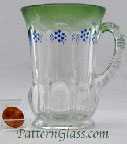
This
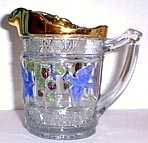
goblet in the U S Glass Co. MICHIGAN state pattern ca 1902 has
a green
stained rim and a blue enameled flower decoration- yet another form
of color decoration used on EAPG.
|
|