| Introduction: In current vernacular, the term Pattern Glass refers to Early American Pattern Glass made ca. 1850 - 1910. Glass pressing began in America during the 1820s & during the first 10-20 years, the process was quite primitive and most of the products were what we now call "Lacy Glass". During the late 1840s, the pressing process was improved enough that some glass companies began to make dishes in forms that were usable in the family home. The glass used to make these dishes is what we now call 'Flint Glass'. One of the enduring myths of antique glass is the term "Sandwich Glass" which is used by some to describe all early glass. But there were many glass houses besides the Boston Sandwich Glass Co. that made this early flint glass. |
| Flint
glass refers to glass made with powdered flint & later lead, produced in
the United States & the United Kingdom from the 1820s
through the 1860s. The term, "flint glass", was given to better
glassware, perfected in England, because
powdered flint was added to the glass formula to improve clarity. At a later date, a lead compound was added and it was found that it gave the glass much more clarity, resonance, and weight. Soon after, the powdered flint was dropped from the glass mixture, but the name was entrenched in vernacular. It should be noted that the lead in this glass is in an unbreakable chemical bond and will not contaminate the food or drink it holds. |
 |
Prior
to the early 1800s, glassware was made by an intensive & expensive hand blown
method. However in the |
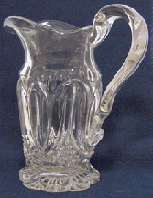
A magnificent flint glass water pitcher in the Tulip & Sawtooth pattern by Bryce, Richards & Co. ca 1854. |
| The first pressed glass from the late 1820s was called "Lacy" glass (see article on lacy glass HERE) as the patterns were very intricate. All lacy glass contains flint or lead. The pressing methods gradually improved & by the late 1840s, pressed glass dishes were made in large quantities & became affordable to the average household in patterns such that different forms matched in design. This mass produced "flint glass" was certainly a part of the American Industrial Revolution. |
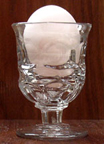 |
The pressed patterns from 1845 through 1865 evolved from plain, to geometric, to ribbed, and realistic and the number of forms available in each of the patterns increased. On the left is an early Argus pattern egg cup. (Read about egg cups HERE.) | 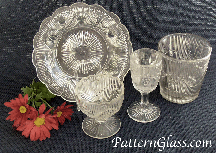 |
| The earlier pieces were quite heavy, and as the glass making techniques improved, the amount of glass invested in each piece was less and the walls of the | Above forms, a plate, egg cup, wine goblet & bar tumbler in Bellflower pattern ca 1850. |
|
 |
vessels were thinner. By the early 1860s, chiefly because of the American Civil War, lead was becoming scarce and expensive. An alternative formula was developed in about 1864 and the use of lead in pressed glass was reduced in favor of the new glass formulas that were called "lime" or "soda lime" glass. This is now referred to as "non-flint" glass. It was the preferred glass for pressed pattern glass thereafter. |
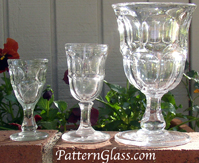
| Flint stems in Ashburton pattern by the New England Glass Co. ca 1860s. From left, cordial 3 1/2" tall, wine 4 1/2" tall & water goblet 6 1/4" tall. |
Most of the factories changed their methods & formulas in the mid to late 1860s and by 1872,
the use of lead in pressed glass tableware had about been phased out. Most of the glass formulas for flint glass called for 33% lead, which is about the same percentage as present |
| day Waterford Crystal. Most department
stores & glass shops today sell crystal that usually runs between
24% and 28% lead. The characteristics of the traditional pressed flint glass pieces are: they have superior light refraction (brilliance); a resonance when struck (bell tone); and are rather heavy. They are beautiful works of American craftsmanship. Although the pieces were pressed in a mold, the pitchers, creamers, & mugs had the handles |
 |
 |
|
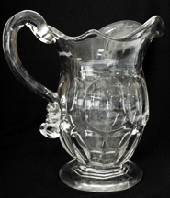 |
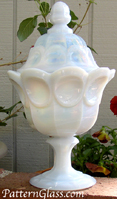
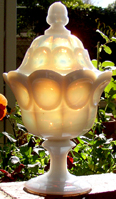
applied separately by hand. These still hot straps of glass were stuck near the top of the vessel, formed into an ear-shaped handle & stuck to the lower portion of the vessel. A curl was formed & crimped at the bottom. | A very rare Colonial pattern
10" tall cov'd sugar in fiery opalescent, so-called because of the fiery effect of sunlight shining through it. Possibly Curling, Robinson & Co. ca 1856. |
|
| The creamer above is Ashburton pattern & an example of the early heavy creamers with applied handles. Read more about EAPG creamers HERE. |
These hand formed "applied handles" are not found on Early American Pattern Glass made after about the 1870s. While most of the flint glass was clear, some was made in colors including canary, cobalt blue, deep amethyst, green, opalescent, milk glass & clambroth. These are all rare now & most are in advanced collections or museums. |
||
| Some firms advertised "flint glass" in the 1880s & 1890s, but that referred to lime glass that was clear and sometimes white opalescent. It was not leaded glass. |
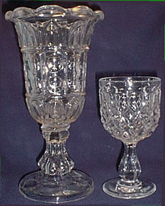 |
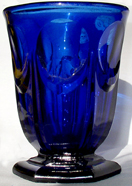
Left is a 10" tall very heavy flint celery vase in a Gothic variant- ca 1860 and a Bakewell Block pattern 6 1/2" tall goblet by Bakewell, Pears & Co. ca 1850s. Right is a flint Bullseye pattern tumbler in rare cobalt blue. New England Glass Co. ca 1850's. |
 |
PatternGlass.com has some select pieces available for sale.
Visit the PatternGlass.com Flint Store by clicking HERE.
| Hal Hooper and his wife, Barbara, live in Spokane, Washington. They have collected Victorian Glass for many, many years and have accumulated a major collection. They are both University of Washington alums and avid Husky fans. | |||
 |
 |
 |
 |