

|
|
|
Far and away, most EAPG was fancy because of the decoration
from the mold surface - that is - the design was formed on the surface
of the pieces because the mold was cut to reflect a design. When the
mold was filled with molten glass, the resultant product was irregular
on the surface from the start. The design so formed was called the pattern. |
Most glass houses
had their own cutters and etching rooms. The cutters did the engraving,
too. |
| Part I Etching Etchings often have a broader subject matter more detailed and sometimes even tells a story. When you run your finger over an etching, it feels slightly rough but usually not substantially deep into the surface of the glass. Acid etching has problems inherent in the process. The acid is exceedingly corrosive, difficult to contain and hazardous to handle. |
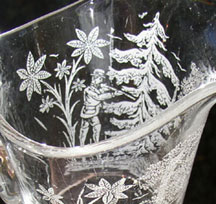 |
This is a Gillinder product; an example
of a pattern that tells a story. The pattern is DEER & DOG aka Frosted
Deer & Dog produced in many forms. The lids have a standing
dog finial which has been etched all over- and so it is called "frosted". |
 |
 |
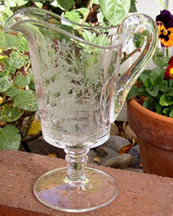
And this is a U. S. Glass Co. product - the OHIO pattern of their popular States' Series. This etching has been accomplished by sand blasting. | 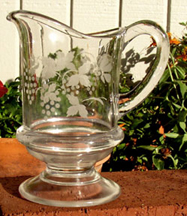 |
| Etching Procedure Unskilled labor workers covered the part of the ware with a black resist, except where the design was to show. Then the item was immersed in acid, which attacked (etched) the glass leaving that part gray or "frosted" looking. Etching is a process of dissolving the surface of the glass with an acid. Originally the body of the glass was covered with a combination of bees wax and lamp black. The bees wax would keep the acid from attacking the glass in unwanted places, and the lamp black made it easy to see. The etcher would scribe a design through the wax resist, perhaps a bunch of grapes, leaves and vines, and the piece would be subjected to the corrosive effects of the acid, either by immersing it in acid or by putting it in a chamber with the acid, allowing the vapors to etch into the glass. Hot water was used to remove the resist and the piece would be ready to sell. These pieces were each unique, the artist had to handle each piece. Soon a method of mass production was developed, the artist scribed the design through the resist onto a steel plate, the steel plate was etched with nitric acid, and then the design could be made from the plate and transferred to the glass, which was then etched. The artist had left the building, and the design was applied by young ladies who had been hired for a pittance. With this advanced process, many pieces could be etched with identical designs, making matching sets of wares. Once the etching plate was completed, the skilled work was done. |
 |
On the left is an example of a common problem of dipping the piece in acid - notice that a portion of the glass intended to be acid etched was missed. |
| The compote on the right is Duncan's FLOWERED SCROLL pattern from 1893. The decor is unique (and rare in this pattern) in that the frosting has been applied only to the raised, molded portion of the pattern design. | 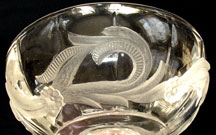 |
| The complexity of the design is dependant
upon the skill of the designer. There are other processes which give the same effect as etching. Geo Duncan and Gillinder used grinding to give a frosted effect on raised panels. Some Crystal Wedding pieces were ground instead of etched. Hobbs perfected sandblasting and used it on the bases of some patterns, Dolphin for one. Ripley further developed the process, making stencils and sandblasting leaves on glassware. This was continued by U. S. Glass on several patterns, Pavonia and Ohio to name two. Sandblasting Sandblasting is done by using compressed air to blow an abrasive material, sand or other media, against the glass, usually with a stencil of some sort to develop the design.The impact of the particles on the surface of the glass interrupts the normally shiny surface, producing the frosted look. It can be simply a uniform gray, or it can be shaded, or even three dimensional, with several different depths. |
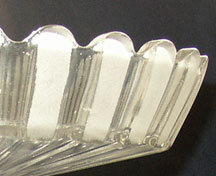 |
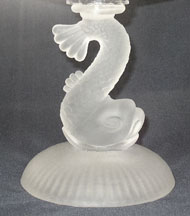
On the left is a portion of a Bakewell FROSTED RIBBON compote which reflects some panels which have been ground. At the right is the famous dolfin standard of the same compote which has been chemically frosted by dipping. |
 |
For an indephth study of etching, we recommend Sid Lethbridge's book,
ETCHED PATTERN GLASS
advertisesed on the PatternGlass.com HOME PAGE below.
Part 2 Engraving
| Engraved designs had discreet, not fuzzy edges. Running your
finger across an engraved piece feels like the design has been "gouged" into
the glass...because it has! |
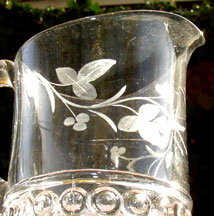 |
This is a BUTTON BAND creamer made by Ripley. The design on the plain portion of the pattern has been engraved by the copper wheel method. Notice the discreet edges compared to etchings. | 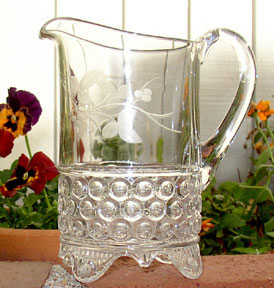 |
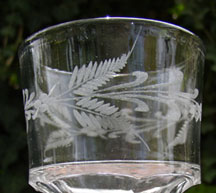 |
FROSTED LION is a popular pattern by Gillinder & Sons, made in the 1870s. Again, the base portion has been frosted by dipping in acid and the top portion has been copper wheel engraved. | 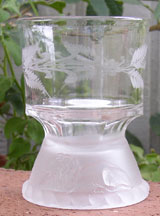 |
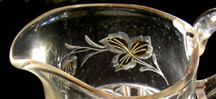 |
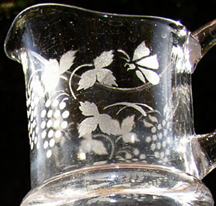
SIX PANEL FINECUT is a Dalzell, Gilmore & Leighton factory product. This creamer has an extraordinary decor in which the design in the clear portion is engraved and then amber stain has been applied inside the leaves. | 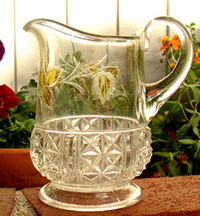 |
Cutting decoratively on EAPG Copper Wheel A
rotating thin copper disk and an abrasive, usually finely ground emery powder
are used for this decoration on pattern glass. The edge of the turning disk
dances across the glass and the emery powder abrades the glass. |
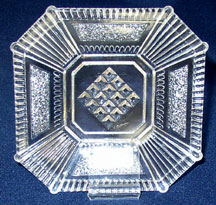 |
This is a tiny little butter pat in Bryce's PLEAT & PANEL pattern to illustrate a decor that can be confusing to a beginning glass collector. The panels of this pattern may look frosted, but they are not. The pattern is in the mold and is called "stippling" - it is simply thousands of little molded dots which almost seem to run together and look frosted. |
| This study is intended as a "primer" and
is certainly not exhaustive as to all the ways that pattern glass was decorated. With profound thanks to Tom Bredehoft for his inspiration and technical input into this page. He is a principal in the West Virginia Museum of American Glass, Ltd. which has a web site reached by clicking HERE. -- and to Mr. & Mrs. John Welker for their inspiration for all that is good in communicating about Early American Pattern Glass. |
 |
 |
 |
 |